A farm bill has just been passed in the House, and another one will be up for debate in the Senate in the fall. Considering all the fuss people like Michael Pollan were making about this bill for months prior I'm surprised I didn't hear more about this as it happened. I didn't sign any petitions or get any requests to call my senator... It seems to me from the reading I've done that the Farm Bill (which only comes up once every five years) is just too crowded with measures and subsidies and rules to ever get anywhere new or change in any way. Subsidies, research, conservation, marketing, food stamps, food aid... all of these are covered by the bill. It is expected that more opposition will build by the time August break is over for the Senate. There's still time to do some grassroots lobbying.
According to the New York Times this is hailed as a victory for Nancy Pelosi, but when I look it over, I'm not so sure... It looks more like she's trying to protect Democratic interests for the coming election. Maybe that's more important than a reformed farm bill, or maybe some of us will be so annoyed we'll vote for the libertarian party...
You can see something of what the liberals think of the House Farm Bill in the San Francisco Chronicle's analysis (the bottom of the article has a good summary of itself).
I just joined this action alert service that's provided by the Organic Farming Research Foundation so that I can keep up a little better with what's going to happen next in the Senate. I think it might get a little more exciting around September...
Tuesday, July 31, 2007


Friday, June 29, 2007
Andean Culture is Older than they thought
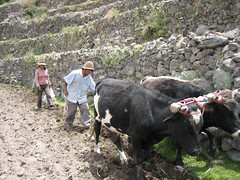 One of the things that first excited me and inspired me to start the seedling project was the idea that history, especially the history of South America, was constantly changing in response to new discoveries about something as hard to preserve as seeds and dirt. According to an article published in Science magazine and quoted in the New York Times, squash was cultivated in the northern Andes 10,000 years ago, which makes South American agriculture nearly as old as that of the Middle East. These kinds of discoveries are slowly changing the way scholars think about the chronology of the civilization of the New World.
From the New York Times:
The researchers concluded that these beginnings in plant domestication “served as catalysts for rapid social changes that eventually contributed to the development of intensified agriculture, institutionalized political power and towns in both the Andean highlands and on the coast between 5,000 and 4,000 years ago.”
The evidence at Ñanchoc, Dr. Dillehay’s team wrote, indicated that “agriculture played a more important and earlier role in the development of Andean civilization than previously understood."
http://www.nytimes.com/2007/06/29/science/29squash.html?_r=1&oref=sloginThursday, June 21, 2007
New Photos Coming Soon
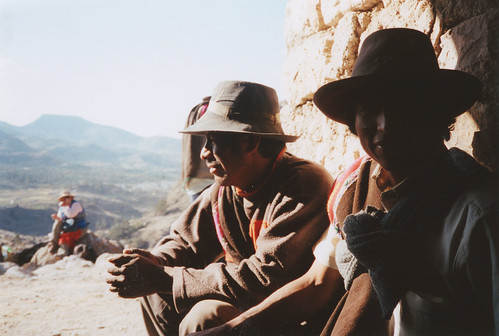
I've just gotten word that the photos I took with my film camera (the little T5) are being processed. I think that the photos I took with the film camera will be the best, though I am sure they will have whittled themselves down just because the film is old and might not yield the best colors. I also continue working with the old footage, but that means working at the office (where I can use the good facilities) and where I already spend five days a week, so needless to say, it's going slowly.
Friday, November 10, 2006
walking in the footsteps of giants

This New York Times article has beautiful ecology notebooks from 1930s California in its Multimedia section. Ecologists at UC Berkeley are retracing the steps of the first director of the UC Berkeley Museum of Vertebrate Zoology, Joseph Grinnell, who knew that one day, one hundred years from then, we would not have the same California. He knew that we would want to know what has changed, so starting in 1904 he and his team took over 2,000 photographs from all over California, and some 13,000 pages of notes.
His work has begun to move ecology from a descriptive science to a predictive one, and it's not a second too early. According to David Tilman, the McKnight presidential chair in ecology at the University of Minnesota, “The world faces immense environmental challenges that we will only resolve if we can forecast how ecosystems respond to alternative practices and policies.” New data and old will be celebrated when the UC Berkeley has its centennial celebration.
Grinnell's vision for the collection is posted on a plaque outside the library. “I wish to emphasize what I believe will ultimately prove to be the greatest purpose of our museum,” he wrote in 1910, “and this is that the student of the future will have access to the original record of faunal conditions in California and the West, wherever we now work.”
Talk about a visionary.
Amazon grows more during the dry season
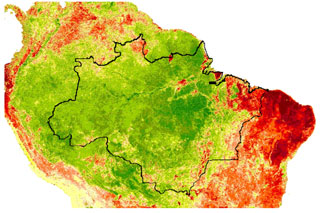
The green color in this image of South America shows vegetation that is growing during during the dry season. Reddish areas "brown down" in the dry season. The black line marks the boundary of the Amazon rainforest -- red areas within the boundary indicate areas where the primary forest has been disturbed. Image courtesy of the Terrestrial Biophysics and Remote Sensing Lab, The University of Arizona.
The Amazon rainforest has been photographed from satellites, the 'greenness' been made into an algorithm, and they've found that old-growth rainforests grow more during the dry season than the wet. It is surmised that older trees have deep roots that can still reach water even during dry seasons when the sky is clear more often and thus more photosynthesis can take place.
This information is a clue in the puzzle about the global cycle of carbon, and has implications for fire regimes in the Amazon, where during El Niño years even tropical forests succumb to fire. This also provides valuable perspective on the ecological cycle of the forests and why old-growth forests are more for sustainable and promote biodiversity.
More at: Monga Bay
Sunday, October 15, 2006
Monday, September 25, 2006
Grasshoppers: A Notebook by Peter Campion...
A book of poetry I read tonight contained the following poem, which struck me as interesting because of something that happened earlier while driving in the darkness to come to a friend's house. After I filled the gas tank and as I drove to the highway along roads my father bicycled as a child I saw an amber sliver of the moon falling into a black horizon from an indigo sky. On the highway I was cut off by a large truck that had just pulled into the freeway, and I had to slow down considerably. I was annoyed and staring at the truck and the cars whizzing by on my left and suddenly an enormous bird flew up and over the bridge and nearly crashed into the truck that was just in front of me, and then he flew away. He must have been a large owl. Probably a great horned owl. I've seen a couple. They are beautiful birds. I've only seen their eyes in photos because usually I see them at night, in a tree or sitting on top of a telephone pole, hunting. All I see is their silhouette, and they have very charming ear tufts that stick up on top of their head. They have a lovely deep Whoo.
It disturbed me, this owl sighting, because I do not like to think of owls crashing into trucks on the highway. And I thought of a girl I had seen that afternoon who I'd known in high school (we ran into each other at the stationary store) and how once when Arwen and I were riding with her she ran over a skunk on the highway. It was horrible. One or two of us screamed. It could have been me who screamed, I couldn't tell. I hate to see poor little things whose lives have been so altered by human existence. I once stopped to let a baby fawn with wobbly legs (newborn) cross the road after his mum. It was a rainy day and I was shaken just thinking of how close I came to hitting that baby thing. So tiny. I cried all the way to school that morning.
And then I read this (my eyes just glanced over the page).
There was dying here tonight, after
dusk, by the road: an owl,
eyes fixed and flared, breast
so winter-white he seemed to shine
a searchlight on himself, helicoptered
near a wire fence, then suddenly
banked, plunged, and vanished
into the swallowing dark with his prey.
From The Hearth by C.K. Williams
Subscribe to:
Posts (Atom)